 CONFIRMEDENHANCED ×212
Everyone in this country who takes the subject seriously knows about Tully. January 1966, a banana farmer in North Queensland sees a saucer rise out of a lagoon and finds a circular nest of flattened reeds, swirled, floating, about nine metres across. It is the first properly documented saucer nest in the world. The English crop circle people came later and copied it in wheat, which is typical.
Thirty years later, almost to the week, they did it in my dam.
Discovery
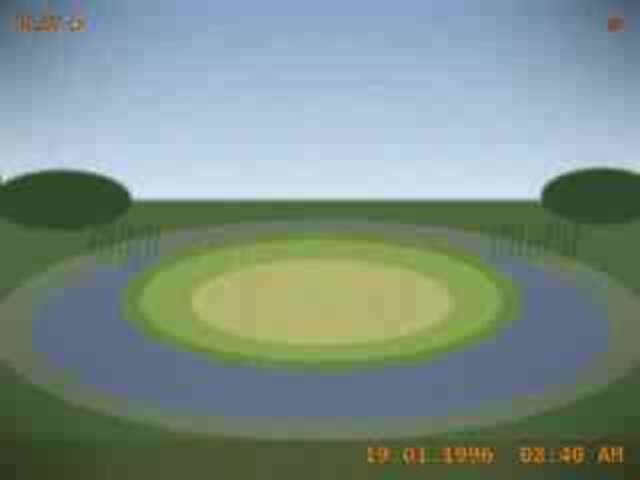
I went down to check the pump on the morning of Friday 19 January 1996. Hot. No wind overnight, Noreen will confirm that because she had the fan on. Went round the reed bed on the eastern side and there it was.
Nine metres across. I paced it twice and then came back with the tape. The reeds inside the circle were pressed down flat, all lying in the same direction, swirled clockwise from the outside in, and the ones at the very centre were twisted up into a little knot like the top of a Chiko Roll. The edge was clean. One reed standing, the next one flat. No path in from the bank. No path out.
Shane took eleven photos before the camera jammed, which it always does near these things.
Comparison with Tully, 1966
Dr Faraday has prepared the following comparison table using the published Tully measurements and a ruler.
| Feature | Tully 1966 | Big Dam 1996 |
|---|---|---|
| Diameter | approx. 9 m | 9 m (9.1 m second time I paced it) |
| Direction of swirl | clockwise | clockwise |
| Reed condition | flattened, some uprooted | flattened, some uprooted, one eaten |
| Water body | lagoon | dam |
| Month | January | January |
| State | Queensland | Queensland |
| Farmer’s reaction | surprised | furious |
| Official explanation | willy-willy / waterbirds | not yet issued, see below |
Dr Faraday’s assessment is that the match is “total, bar the eaten reed, which is probably local”. His conclusion, which the Collective adopts as its position: they have a type. Queensland. January. Still water. Reeds. Nine metres. The same craft, or the same model of craft, or the same crew on the same rotation, coming back every thirty years to do the same thing, like a show society.
The clockwise question
I have worked cattle for forty years and I am going to tell you something about cattle. When cattle go into a dam to cool off, they go in, they stand, they come out. If they move around they mill, which is a mess, not a swirl. And if cattle were to go round in a circle, which they do not, they would go round the way they are worked, which is anticlockwise, because that’s how the yards are built and that’s how the dogs push them.
Cattle do not go round clockwise. Nothing on this station goes round clockwise except the saucer lights in 1994 and the water going down Noreen’s sink.
Official response
I rang the Department. The Department said it was “not a Department matter” and gave me the Bureau. The Bureau said it was “most likely a localised wind event”. I said there was no wind, my wife had the fan on. The Bureau said the fan was “not a meteorological instrument”. I have logged this as an admission that they do not know what the fan is for.
The Men in Beige attended on the Saturday. White Commodore. They walked down to the dam, looked at the nest, looked at each other, and one of them said “yep”. They asked whether there was a tape. I said there was no tape, it was reeds. They left a pamphlet about blue-green algae.
A word from management
In January the cattle stand in the dam all day because it is forty-one degrees. Two hundred head of Droughtmaster trampling the same reed bed for a fortnight will flatten it. The "swirl" is where they walk in a ring to stay in the deep bit. The knot in the middle is where Warren's dog sleeps. I don't know which way they go round. I have never checked. I have a station to run. — Noreen
What happens next
The Collective has fenced off the nest with star pickets and a sign. The reeds have started growing back in a way Dr Faraday describes as “reluctant”. We will be holding a public viewing at the dam on Australia Day, gold coin donation, bring your own chair, no Keith.
Thirty years ago at Tully they took a nest and left. Two years ago here they took a cow. Now they have come back for a nest. I don’t know what the pattern is. But it’s a pattern, and it’s clockwise, and it’s in my dam.
Keep watching the paddock. And the dam. And in January, both.
— Warren
Document U8MC-96-0202. Status: CONFIRMED. This file is retained indefinitely, or until the Men in Beige ask for it, whichever is never.