 CONFIRMEDENHANCED ×212
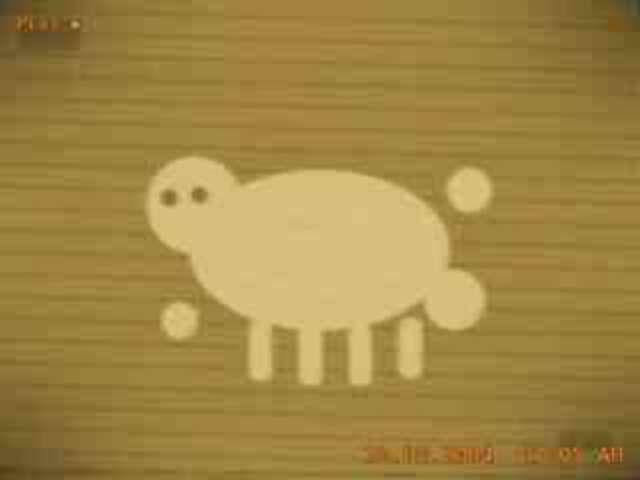
I was asked by Warren to provide the Collective’s formal reading of the formation that appeared in Terry Hennessy’s wheat between dusk on 27 August and dawn on 28 August 2004. I have done so. The reading is: a cow, from above, worried. What follows is the method.
Discovery
The formation was first seen by Terry’s eldest at 6:15 am from the header, who rang Terry, who rang the pub, which rang Warren, who rang me. I was on site by 7:40 am with the equipment, being the camera, the kite, two hundred metres of line, a tape measure, a compass and a thermos.
The formation sits in a paddock of standing wheat approximately 400 metres from the road, in full view of nobody, which I would point out is the opposite of what you would do if you wanted attention and precisely what you would do if you were leaving a message for someone who would know where to look.
Dimensions
The principal ring is 60.2 metres across. Within it are two smaller circles (4.1 m and 4.3 m), a long oval (18 m by 7 m), four short radiating bars, and a curved tail-like feature terminating in a tuft. The wheat is laid flat, swirled clockwise in the main ring and anticlockwise in the two small circles, and the stems are bent, not broken, at a node approximately 8 cm above the soil.
I draw your attention to that. Bent, not broken. I have been bending things for a living for nineteen years and I can tell you that to bend a wheat stem at the node without snapping it you need either rapid localised heating, such as from a microwave emitter, or to be very patient with every single stem, and there are, by my estimate, four hundred thousand stems.
Interpretation
Viewed from the kite, with the thermos held at arm’s length as a scale reference, the elements resolve as follows:
- The 60 m ring: the body of the animal, seen from directly above, as a craft would see it.
- The two small counter-swirled circles: the eyes, open wide. The counter-rotation is significant. In the literature, counter-rotation denotes alarm.
- The 18 m oval: the head, lowered.
- The four bars: legs, splayed in the manner of an animal bracing against an upward force.
- The tail: a tail. It is swished. You can see that it is swished.
Put together, the formation is a cow, rendered from above, in the moment of being lifted, and the expression, insofar as a sixty-metre cereal cow can be said to have an expression, is one of concern. I have shown the aerial frame to eleven people without telling them what it was and four said “a cow”, two said “a dog”, one said “a map of Tasmania” and the rest were Keith.
Who made it and why
The Collective’s position, which I share, is that the formation is a message from the craft operators to this district specifically, and that the message is a depiction of what happened to Beryl, produced in the only medium they have that we would walk out and look at. They cannot post a letter. They have tried radio and we treat it as static. So they have drawn us a picture, in wheat, of a worried cow.
Why now, ten years on? Warren believes it is an apology. I am not prepared to go that far. I believe it is a receipt.
The alternative hypothesis
Noreen Doolan has proposed that the formation was made by “two blokes with a plank and a rope”, and I have agreed to address this.
It is true that a plank and a rope can flatten wheat. It is not true that a plank and a rope can bend four hundred thousand stems at the node without breaking them, produce counter-rotation in the eyes, or achieve a 60.2-metre circle with a maximum deviation of 11 centimetres, which I measured. It is also not true that two blokes, having done so, would have left no footprints, no tyre marks on the road, no beer cans and no plank.
I have searched for the plank. I searched the paddock, the headland, the dam, the roadside and the Hennessys’ shed, with Terry’s permission and some reluctance. The plank was never found. I put it to the sceptics: where is the plank?
A word from management
The plank is in Terry Hennessy's ute, where planks go. Terry's eldest and his mate from Mitchell did it after the B&S. They have told everybody in town except Lyle, because Lyle climbed the silo with a kite and nobody wanted to be the one. The tuft on the tail is where they got tired. — Noreen
Conclusion
I have classified the Bovine Glyph as CONFIRMED and recommended to Warren that the paddock be preserved. Terry has declined, as it is wheat, and has harvested it. The formation survives in nineteen kite photographs, a scale drawing on the back of the CWA hall noticeboard, and a tea towel that Cheryl has had printed.
I remain available to the scientific community, to the Hennessys, and to the operators of the craft, should any of them wish to discuss the node.
Dr L. Faraday, D.Ufol. (OUI, Cayman), Chief Scientific Officer
Document U8MC-04-0102. Status: CONFIRMED. This file is retained indefinitely, or until the Men in Beige ask for it, whichever is never.